The Reverse of the Great Seal of the United States // 1782
The unfinished pyramid first appeared on the reverse of the Great Seal of the United States in 1782. The seal was designed by a committee — Charles Thomson, Secretary of Congress, with contributions from William Barton, a heraldry expert. The obverse shows the eagle. The reverse shows the pyramid. The reverse was considered the spiritual side of the seal.
It was not placed on currency until 1935, when Secretary of Agriculture Henry Wallace — a committed Theosophist — brought both sides of the seal to President Franklin D. Roosevelt. Roosevelt, a Freemason of the 32nd degree, immediately recognised the significance. The reverse went on the dollar bill that year.
The pyramid has thirteen courses of stone. Thirteen colonies. Thirteen also corresponds, in various Masonic traditions, to the number of degrees separating the outer initiate from the inner sanctum. The capstone floats above, separated from the body of the pyramid by a field of light — the Eye of Providence at its centre. The Latin beneath reads Novus Ordo Seclorum: New Order of the Ages. Above it, Annuit Coeptis: He has favoured our undertakings.
The question the historians do not ask is: whose undertakings. And who is He.
The eye above the incomplete pyramid signals an unfinished project — a world still being constructed toward an endpoint the designers understood and the public did not.
Programme of a New Secular Order // The Architecture of Unfinished Power
The pyramid as a symbol predates its American application by thousands of years. In its oldest documented use, the pyramid represents the hierarchical organisation of knowledge and power: the base is broad, accessible, uninitiated. As you ascend, the number of people narrows. At the apex — the capstone — sits a very small group who hold the complete view.
The key detail in the American symbol is what is missing. The capstone does not sit on the pyramid. It hovers. Detached. Illuminated. The separation communicates something specific to anyone trained to read it: the structure is not yet complete. The project is ongoing. The work continues toward a point of consolidation that has not yet arrived.
Manly P. Hall, Freemason and scholar of esoteric traditions, wrote in 1944 that the reverse of the Great Seal contains "a plan for a philosophic empire." He was not writing metaphorically. He believed the founders were initiates of a tradition extending from the ancient mystery schools — that the United States was designed as the vehicle for a particular completion. A new order, not in the sense of a new beginning, but in the sense of an order finally realised.
William Cooper documented in Behold a Pale Horse that the symbol functions as a communication system — from those who understand the plan to those being initiated into understanding it. The seal was placed on the currency not as decoration. It was placed where every citizen would handle it daily, most without ever reading it. This is how the language of symbols operates: in plain sight, functioning as transmission, decoded only by those who know what they are looking at.
The Eye That Wakes // The Decoder Made Public
The inversion principle does not destroy the original symbol. It does not dismiss it. It takes the symbol apart, documents it, and redistributes what it means to those who were never meant to receive it.
The pyramid is unfinished because we are unfinished. The project described by the symbol — the hierarchical consolidation of power at a capstone level — is only possible while the base remains uninformed. The entire architecture depends on the majority not reading the symbol. The moment the base reads it, the function of the capstone changes.
The eye in the original symbol watches from above — omniscient, detached, illuminated by privilege of position. In the inversion, the eye does not watch from above. It is the eye of every person who looks at the structure and recognises what they are seeing. The pyramid does not disappear when you see it. But the power dynamic embedded in it shifts the moment the base can read the capstone's language.
Jordan Maxwell spent fifty years documenting that the eye symbol across world traditions represents not divine surveillance but solar illumination — the eye as the source of visible reality. The original symbol placed this seeing-power in the capstone. The inversion places it in whoever wakes to look. The inverted pyramid below is the architectural expression of this shift. The decoder has been redistributed. The key is now public.
File 001 — The Capstone // The Garment as Document
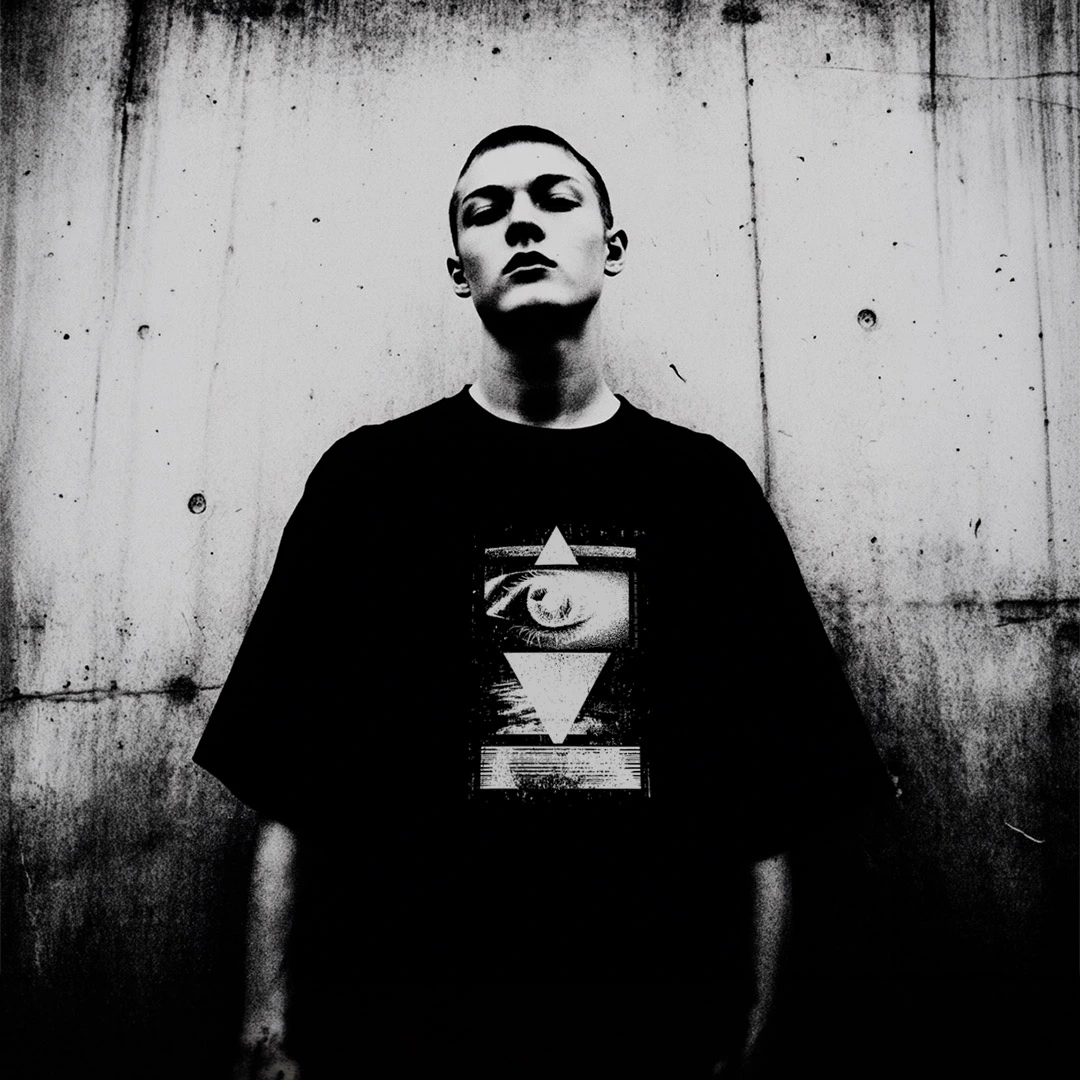
File 001 places the eye between two triangles. The upright pyramid above — the original symbol, the structure being constructed toward hierarchical completion. The inverted pyramid below — the inversion principle applied. Both visible simultaneously. The eye, in the centre, does not choose a side. It sees both.
This is not decoration. Every element of the design is documented here. The eye between the two triangles communicates a specific position: awareness of the structure, without allegiance to either direction of it. The archivist who wears File 001 is not claiming to have solved anything. They are claiming to have seen something — and to carry the record of it.
The garment is the surface. The decode is the depth. The two are inseparable — published simultaneously at the moment of declassification, never separately. The clothing without the decode is merchandise. The decode without the clothing is a document that stays on a screen. Together, they make the information wearable.
File 001 is limited to 500 editions. It will not be reprinted. When it closes, it closes permanently. The archive entry — this document — remains open indefinitely. The garment is the transmission. The archive is the record.